

Delhi Transmission Project
Project Overview
Wabash Valley Power Alliance, a not-for-profit generation and transmission electric cooperative, serves wholesale power needs for 21 electric distribution cooperatives in Illinois and Indiana, including MJM Electric Cooperative (MJM). We’re investing in infrastructure enhancements as part of our commitment to meeting your energy needs today and preparing for the future.
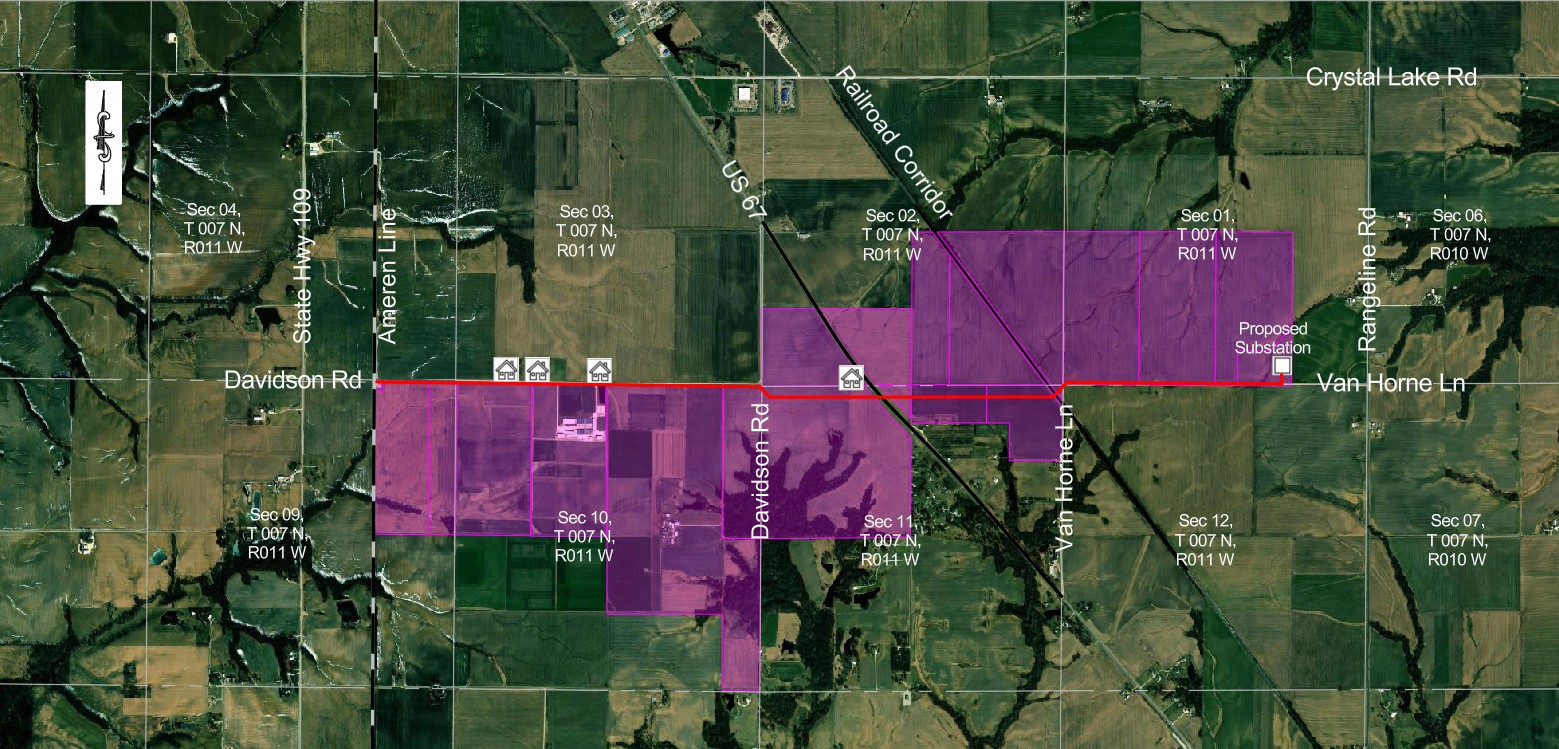
Wabash Valley Power will build a 69 kV power line to connect the planned Delhi Substation, near Jerseyville, Illinois, to an existing Ameren transmission line.
Project Benefits Include
 Improved energy reliability for local homes and businesses
 Support area economic growth
 Enable future regional expansion
The power line will be owned and operated by Wabash Valley Power. The construction of the transmission line and substation will improve electric service reliability and help meet the local needs of MJM’s members.
WORKING TOGETHER
As a co-op, we are owned by and governed by the people we serve. We answer to them, not stockholders in faraway places. We recognize the opportunity economic growth brings to any community. We also realize there may be hesitancy. Building transmission infrastructure like this is a large undertaking.
As we take on this project, our focus is on minimizing, as much as possible, the impacts to people and the environment.
Our commitment is to be…
Collaborative: gaining insights from landowners to understand property concerns
Open & Honest: communicating honestly about the project’s process and progress
Empathetic: understanding this is a community made up of people who care deeply about it
If you have any questions, you can reach us by email at delhi@wvpa.com.
General Project FAQs
What is the Delhi Transmission Line Project?
+×The project includes a new 69 kV power line to connect the Delhi Substation, which will be constructed near Jerseyville, Illinois, to an existing Ameren transmission. The construction of the transmission line and substation will improve electric service reliability and help meet the local needs of MJM’s members.
Who is involved in this project and what are their roles?
+×- Wabash Valley Power Alliance – Project owner
- MJM Electric Cooperative – Your local electric cooperative and a member-owner of Wabash Valley Power
- Toth & Associates – Consulting engineer and land agent
– Ernie Garza, Right of Way Agent, can be reached at (417) 848-7476 or
egarza@tothassociates.com - Zahner & Associates – Survey subcontractor
How are transmission lines built?
+×Construction primarily takes place during daylight hours, but some work may be completed after dusk. Additionally, our contractors may travel to and from the job site before dawn or after dusk. Crews may have traffic control in place during construction. Affected landowners, who have signed an easement will be contacted in person, by phone and/or in writing at least 24 hours prior to the beginning of construction on their property.
Why is the Delhi transmission line needed?
+×This project is necessary to promote grid reliability, relieve congestion to the energy grid, and meet local energy needs.
What is the route?
+×See the route on the sheet here.
What will it look like?
+×Although several different structure types may be used, depending on the presence of existing infrastructure and site-specific conditions, the most common conceptual design employs galvanized steel single-pole structures directly embedded into the ground or bolted onto concrete foundations and supporting a single-circuit 69kV line with intermittent underbuilds of lower voltage distribution lines. Above the circuit will be one optical ground wire (OPGW). The wire will shield the conductors from lightning and provide a path for internal as well as third party communications. Structure heights are anticipated to range between 55 and 75 feet above ground and pole-to-pole spans are anticipated to be 200-300 feet in length, dependent upon terrain and the presence of electric distribution line(s) that may be underneath the transmission line.
How does west central Illinois benefit from this project?
+×This project will support regional growth and improve reliability. The line also will relieve load congestion at several nearby substations while providing for additional capacity, strengthening reliable service for those in the region.
What is the benefit of this project for Wabash Valley Power?
+×The new Delhi substation and 69 kV transmission line will relieve congestion at two nearby substations while also improving the quality and amount of electricity delivered in the region.
What is the benefit of this project for MJM Electric Cooperative?
+×This new substation and 69 kV line will provide additional reliability while providing capacity for future load growth. This will improve the amount and quality of energy being distributed in the areas surrounding the substations.
Will construction of the transmission line raise MJM Electric rates?
+×This project, and MJM Electric’s involvement with it, will not result in a noticeable rate increase for cooperative members. This is because it is a part of the MISO grid, a network of transmission connections extending from Alberta to Louisiana through the mid-section of the USA. MISO absorbs the costs of this project in its overall transmission rate all utilities in its network pays. This results in an impact to rates that is measured in fractions of a penny.
When will the project begin?
+×Construction is expected to begin in early 2027 and placed in-service in the end of summer 2027.
What is the impact to any endangered or critical species in the project area?
+×The project will pose no impact to endangered or critical species during the life of the project.
Who do I contact for construction questions or concerns about the Delhi Project?
+×There are several ways to contact us with questions.
- Phone: 888-997-0766
- Email: Delhi@wvpa.com
Landowner FAQs
What happens during the real estate process?
+×Landowners will be asked to grant an easement to Wabash Valley Power for the right to use a defined strip of land for the construction, operation and maintenance of the electric transmission line. Toth & Associates, on behalf of WVPA, will be working with landowners on the easement acquisition process. Toth agents will meet with landowners to discuss easement rights, compensation, survey work, damage settlements, structures, damage settlements and land restoration. If you would like to contact us, please contact your land agent at Toth & Associates.
What are soil surveys?
+×As a part of the Project, engineering staff will design the foundation for each transmission line structure. The field data we collect will help our engineers determine the final design and structure locations, and will help to minimize impacts to cultural and biological resources during construction. The design process requires information about the soil where the structure will be located. Collecting soil information is completed using the following steps by our geotechnical field survey crews:
- Partner with our real estate team to coordinate property access.
- Gather samples from each site by digging a 4-6 inch wide hole into the ground, known as a soil boring. Soil boring areas will be filled back in after the survey.
- Review samples to determine the physical properties and layering of the soil.
- Use soil information to design each foundation and structure dimensions.
How much of my yard will it take out?
+×The dimensions change from landowner to landowner and you should have an exhibit for your specific property. Typically, easements are 70 feet from the centerline of the road, though our intent is to have poles to be installed closer to the road rather than the middle of the easement. If you have a specific questions about your property, please contact your land agent.
Why my property?
+×When this project was engineered, we worked to determine a route that would be most efficient while also allowing for the greatest improvement in service. In balancing the goal of improved reliability and cost- efficiency in construction, we picked the best route to accomplish that task.
What happens to my trees?
+×We take every measure to preserve trees and existing landscapes. The trees on site are considered when designing these projects. When possible, we work with the natural landscape. Trees and vegetation are the number one cause of outages, which are inconvenient and expensive when damage to power lines and equipment is sustained during a storm. Limiting the potential for vegetation to come into contact with lines is a part of the engineering process along with the operation and maintenance of the transmission line. For that reason, most vegetation, including trees and scrub brush, has to be removed in the easement. However, most of the time, we can avoid removing landscaping and flowers.
Why this particular route?
+×Through an exhaustive analysis, this route was chosen because it was the best possible location to get the most cost-efficient utilization of resources and benefit the most members. This route will affect the least landowners and allow for more members to receive the added reliability and voltage this project will bring to the system.
Why not across the road?
+×When placing power lines, road crossings are one of the most expensive and dangerous parts of construction and operation. In the engineering process, we aim to minimize road crossings as much as possible. Which side of the road a line sits along is determined, in part, by getting to the lowest number of road crossings possible. Additionally, a route sometimes has to work around areas where ROWs cannot be granted or engineering has determined line placement is not feasible.
What will the poles look like?
+×As a transmission project, the lines will be taller than you’re used to. We do this to allow for both distribution and transmission cables to run along the same path. Transmission lines sit above distribution lines and carry a higher voltage. Rather than wood poles to hold the lines that just bring power to your homes, we will be installing steel poles that can hold these high voltage lines as well. These taller, higher voltage transmission lines carry power between substations and improve reliability and function of the overall electrical network.